

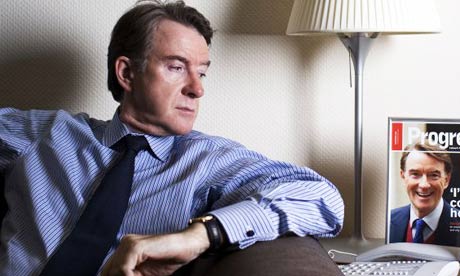
Where the global economy is concerned, Lord Mandelson is an unreconstructed optimist. On a flying visit to Auld Reekie last Friday, the Labour peer, who rejoined the cabinet as business secretary last October, had the air of a missionary. A missionary not for peace or religion but for optimism, and for a new type of government “activism”.
Despite the gloomy and uncertain backdrop — which last week saw the closure of Dundee’s NCR plant and hefty financial losses at both RBS and HBOS — Mandy also said he was confident that he could see small signs of recovery. “Without starting to spot green shoots, I believe we are starting to see some green seedlings around the place,” he said.
Cautious positivism seems to come more naturally to Mandelson than to cabinet colleague Shriti Vadera. On his Edinburgh visit, he was sanguine about Britain’s future position in the world.
Confidence was on the menu at a breakfast meeting with Archie Kane and Susan Rice of Lloyds Banking Group, who were joined at the Mound by the likes of Jim McColl of Clyde Blowers and Keith Miller of the Miller Group. Mandelson also found time for a 15 minute private meeting to tell CBI Scotland director Iain McMillan about this wonderful thing called hope. Mandelson’s core beliefs are that the global economy will double in size by about 2029 and that UK businesses have to ensure they are able to capitalise on this growth when it comes (those in sectors such as renewables and high-tech will receive government support).
He said emerging economies such as India and China are not going to lose their appetite for a better quality of life and their inhabitants will continue to demand better quality goods. In this context he thinks it is essential that UK businesses do everything they can to retain capacity and capabilities in terms of plant, machinery, people and R&D. Otherwise, Mandy warned, they are going to lose out in the hi-tech, low carbon economy of the future.
In the short-term, Mandelson also urged Scottish exporters to take greater advantage of the current weakness of sterling to gain early inroads into burgeoning global markets and thereby position themselves for recovery.
The Labour peer was also adamant that his party knows best when it comes to extricating us from the economic ordure. He preached joined-up government between Westminster and the nations and regions of the UK and yet denigrated what he sees as the misguided policies of the SNP on issues such as nuclear energy and public sector reform. Mandy accused Alex Salmond’s government of irresponsibility in seeking to differentiate Scotland and the way it has picked fights with Westminster on government funding. He also stressed that the recession has shown there is zero economic case for breaking up Britain.
Paradoxically, however (if things like public sector reform and nuclear energy can be ignored) Mandy’s vision of a smarter, successful Scotland is not so different from that of the SNP. Much of it, including the need to rebalance the economy towards manufacturing, is motherhood and apple-pie.
Mandy brushed aside the expenses row — in which he stands accused of claiming £1,350 and £1,500 to cover home decoration and gardening at his former Hartlepool home in 2004 — as an irrelevance. He insisted the story was part of a “shabby smear campaign that is unsupported by factual evidence”.
In some ways, it was a class act.
Thumbs up for Thatcher
On Monday I attended a debate at the Signet Library on whether the former prime minister Margaret Thatcher had done more good than harm to Scotland. The motion, which was narrowly carried, was proposed by Tories Malcolm Rifkind and David McLetchie and opposed by former SNP MP Jim Sillars and former Labour energy minister Brian Wilson.
The Iron Lady was widely abhorred in Scotland during her 11 years in power but the distance of time and the success of some of her policies has engendered a degree of forgiveness north of the border.
Many present at the debate — held to mark the anniversary of her entry into 10 Downing Street and the launch of a book about her effect on Scotland — cited her most positive legacies as the right-to-buy policy, privatisation, education reforms and her tackling of trade union power. Without Thatcher, the economy in Scotland would almost certainly have been even weaker than it is today.
Let imagination grow
Edinburgh City Council ought to become more imaginative. Owing to new-found caution at Lloyds Banking Group, there is now a massive hole-in-the-ground in the heart of the old town where Mountgrange had been hoping to erect its hugely unpopular Caltongate development.
According to property experts this is likely to remain a vacant site for at least the next three to four years.
So perhaps councillors should listen to local residents who have suggested that the cleared former bus garage should be turned into an adventure playground and allotments for Edinburgh’s younger generation — at least until administrator Deloitte manages to sell on the site.
After all, play is a human right too.
This Scottish Agenda column was published in The Sunday Times on 10 May 2009
Pretty thought-invoking post – raises some interesting points for debate. I just stumbled upon your blog this morning and wanted to say that I have really liked browsing some of the posts. Anyways, I’ll be subscribing to your feed and I hope to read more very soon!