

Photo: copyright © Ian Fraser
To many of the Royal Bank of Scotland’s customers and staff, and to the taxpayers who bailed it out nine years ago, it seems like another massive slap in the face.
The bank announced it is to close a further 62 branches across Scotland, a move that prompted some observers to conclude that – in spite of a recent TV ad campaign, in which the bank claimed to be the “Royal Bank FOR Scotland” – RBS is, in fact, the “Royal Bank for Nowhere”.
Large parts of Scotland will now lack any physical RBS presence, with the Borders and Highlands being particularly badly hit. After the closures, the bank will have just 89 branches left in Scotland, as well as two dedicated cash and deposit stops for businesses, plus a fleet of 20 mobile vans.
RBS is by no means alone in savaged pruning its branch network. All UK banks say customers are visiting branches less as they switch to banking online. Already this year, two other banking groups – Clydesdale Bank parent CYBG and Lloyds Banking Group – have announced the closure of 75 Scottish branches between them.
It costs a bank substantially less if it can persuade customers to most of their banking online and using mobile apps, than to sustain a comprehensive branch network dating back to the Victorian era, with all the costs that this entails including maintaining properties, paying energy bills. paying business rates and paying staff.
But given RBS’s avowed intention of becoming the “UK’s number one bank for customer service, trust and advocacy by 2020”, shutting down one-third of its branch network in Scotland with the loss of 158 jobs seems mightily odd.
The situation seems worse when you consider that, in its “Customer Charter” of June 2010, the state-rescued institution made a public commitment to not shutting down any branches if they were “The Last Bank in Town”. It reneged on this promise at its annual general meeting in June 2015 , saying it the pledge was proving impractical.
Visiting a branch may seem old school but it remains a way of life for many people – older people and small businesses in particular. A report into closures by Professor Russel Griggs has likened losing a local branch to “a bereavement” for some people.
Businesses, especially smaller, cash-intensive businesses like pubs and independent retailers, are concerned about the practical problems, time and expense associated with having to travel further to get change and to deposit cash or cheques. They also generally prefer face-to-face meetings with bank staff when seeking advice about growth and finance.
Andy Willox, Scottish policy convenor of the Federation of Small Businesses, said: “Ultimately, these changes will make it more difficult to run a business in much of Scotland – including many deprived communities and tourism hotspots.” Last year, the FSB published a detailed study showing that then free circulation of cash remained vital to the survival of many local economies.
Trade union Unite, which represents many of the workers who are spending Christmas in the knowledge they risk losing their jobs next summer, is incredulous and suspects the closures spell the end of UK branch banking. Regional officer Lyn Turner accused senior figures at RBS of “filling their boots while they devastate local communities” adding that what they are doing “amounts to institutional financial vandalism on a scale which has never been seen in this country ever before. Customer service? Trust? Don’t make me laugh.”
In a memo to members the trade union said: “The sheer scale of this latest round of branch closures is savage. How can a UK taxpayer backed organisation devastate local communities by disenfranchising them of the ability to bank at their local branch? “Once again loyal staff, that have helped to rebuild RBS over the last decade, will be rewarded with the prospect of an uncertain future and a bleak Christmas.”
The political reaction to Friday’s announcement has been one of shock and dismay, with politicians from all the major parties calling on the bank to either reverse its decision or do whatever it can to mitigate the carnage.
Senior politicians including secretary of state for Scotland David Mundell and Scottish business minister Paul Wheelhouse want meetings with the Gogarburn-based bank’s top management early next week. Conservative MSP finance spokesman Murdo Fraser said: “This will hit small communities particularly hard. I’m calling on bank bosses to think again.”
Peter Wishart SNP MP for Perth and North Perthshire said RBS “must reconsider” its cuts plan, while western Isles nationalist MP Angus McNeil said he was “Flabbergasted at the proposed economic vandalism suggested by RBS with these branch closures. “They will have to drop ‘Scotland’ from their name to stop giving false impressions. It is now easier for Dover people to bank in Calais than what they suggest for Castlebay, in Barra”
But experience suggests that RBS is very unlikely to reverse its plan. The bank’s top management, led by New Zealand-born chief executive Ross McEwan and chairman Sir Howard Davises, have a single goal in mind. They are desperate to return the bank to profitability by 2018 in the wake of nine years of losses, and are no less keen to see the government sell its remaining 73 per cent stake so the bank can be returned it to private ownership.
The duo were cheered when, in the small print of his recent Budget, the chancellor of the exchequer Philip Hammond declared that RBS has now been turned around, and that the UK government wants to restart share sales by April 2019, with a plan sell tranches of £3 billion worth of government owned shares each year over the next five years – implying the sale of a total of £15 billion worth of RBS shares by 2022 – even though this would entail a nominal loss to taxpayers of more than £26 billion.
McEwan and Hammond are unlikely to let the complaints of many thousands of unhappy customers in the remoter parts the bank’s empire get in the way of this goal. They are unlikely to lose much sleep over it.
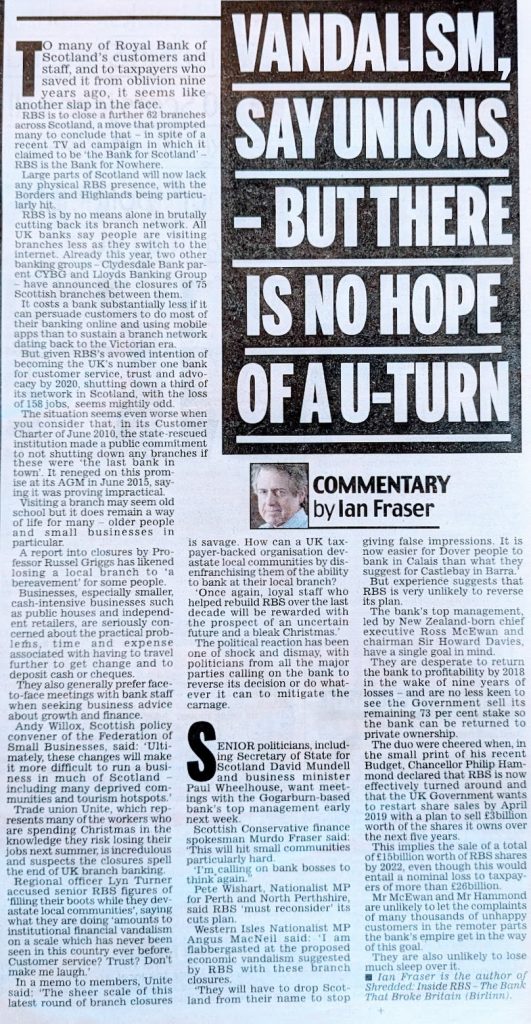
This comment piece was published in the Daily Mail (Scottish edition), to accompany articles headlined “RBS to axe a third of its banks” (on the newspaper’s front page) and “RBS’s bank branch bloodbath” ( on pages 4 and 5) on Saturday 2 December 2017
The article as it appeared in the Daily Mail on Saturday, 2 December 2017