
Chancellor Alistair Darling was in Luxembourg for a meeting of European finance ministers when he was called out of the room: the chairman of Royal Bank of Scotland was on the phone and needed to speak to him. Urgently.
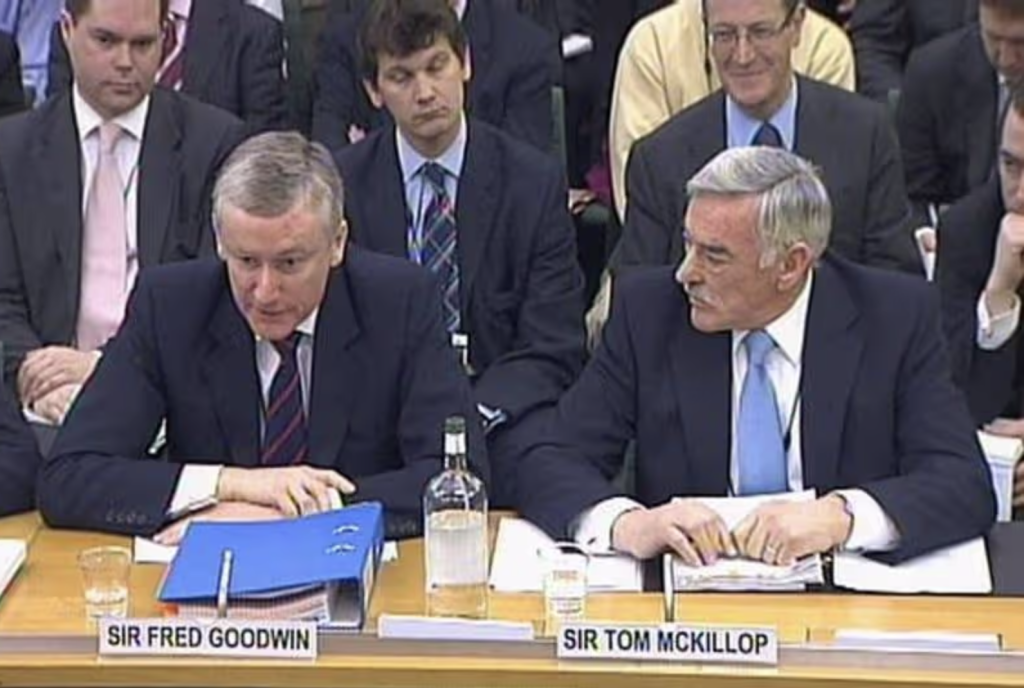
In sombre tones Sir Tom McKillop broke the news. The Royal Bank of Scotland was about to go bust. Shell-shocked Darling asked McKillop how long the bank might be able to survive. “A couple of hours, maybe,” McKillop replied before asking the question that changed the course of British history: “what is the government going to do about it?”
It was 7 October 2008 and, after a decade of crazed growth under former chief executive Fred Goodwin, the Gogarburn-based bank was bloated with toxic assets, its management information systems were atrophying, and it was suffering from indigestion after swallowing scores of banks, many of poor quality, including the hugely toxic Dutch giant ABN Amro. RBS had become the biggest bank in the world – with ‘assets’ of over £2.2 trillion and over 200,000 staff – at precisely the worst time.
But its global success had come at precisely the worst time. In an environment of greed and false optimism that ignored growing economic instability it had become bloated with toxic assets and was suffering from indigestion from swallowing scores of other banks, including the collapsing Amsterdam based giant ABN Amro.
Just a month earlier Lehman Brothers had collapsed and now other large banks were refusing to support RBS on the interbank lending market for fear it too would fail. Wholesale depositors – large firms wishing to park billions of pounds – had been engaged in a “silent” run over the past three weeks, pulling out £35 billion in deposits. The RBS share price was in freefall.
Darling later recalled being chilled to the core by his phone call from McKillop. He knew that if RBS were to fail, it would trigger a financial Armageddon. He said it felt like an enemy power had just unleashed nuclear weapons upon the UK, and that they were due to land in two hours. “It was very scary. That moment will stick with me for the rest of my days.”
Prime Minister Gordon Brown, holed up in No 10, was equally terrified. That day he told aides: “If the banks are shutting their doors, and the cash points aren’t working, and people go to Tesco and their cards aren’t being accepted, the whole thing will just explode. If you can’t buy food or petrol or medicine for your kids, people will just start breaking the windows and helping themselves … It’ll be certain anarchy.”
It was a scenario Brown and Darling were determined to avoid, even if it meant bankrupting the United Kingdom in the process. Darling said: “We would stand behind [RBS] even if it meant using every last penny we had. If RBS closed its doors, the banking system would freeze, not just in the UK but around the globe.”
Darling instructed Sir Nick Macpherson, permanent secretary to the Treasury, to call Bank of England governor Mervyn King and order him to open the monetary taps. Within days, RBS was being kept afloat with £36.6 billion of clandestine emergency loans from the Bank of England, loans whose very existence was not disclosed until a year later.
But Brown and Darling knew there was more to do – they had simply stuck a plaster on a gushing artery. And so, later that morning, the government pushed the button on its so-called “Comprehensive Bank Rescue Plan”, something it had been concocting over the previous three weeks, with advice from firms including UBS, JPMorgan Cazenove and Slaughter & May
Later known as ‘the bailouts’ the plan involved pumping £50 billion of taxpayers’ money into RBS, HBOS and Lloyds TSB as fresh capital, launching a £250 billion credit guarantee scheme, and adding a £200 billion special liquidity scheme.
The prime minister hoped this would be enough to cauterize RBS and other banks’ self-inflicted wounds – lack of capital, lack of liquidity and lack of funding – so they might, at least, be able to restart lending. But the government, misled by the banks’ boards of directors, underestimated the perilousness of the banks’ finances, and a further £25.5 billion of taxpayer-funded capital had to be injected into RBS the next year, together with other support, before it could claim the bank had been stabilised.
This took the UK’s total ‘investment’ in RBS shares to £45.5 billion, giving taxpayers an 84.4 per cent stake in a bank that many of them would probably rather not own.
Ten years on from this hugely expensive debacle, more and more people are wondering if it was worth it? Would it not have been better to let RBS fail, or ring-fence and nationalise its vital organs, such as UK banking and payment services, and put the international and investment banking parts into orderly wind down, as advocated by the Nobel Prize winning economist professor Joseph Stiglitz at the time?
Since becoming a ward of state in October 2008, RBS has hardly covered itself with glory. The thrust of the initial strategy for saving RBS was to “trade the bank out of its difficulties” and flip it back into the private sector for a profit within a couple of years. Goodwin’s successor, the former investment banker Stephen Hester, insisted the bank should remain as a global universal bank – banker’s jargon for a world-straddling, financial services conglomerate which, like Citigroup, seeks to do everything, everywhere – despite the probable conflicts of interest between its various arms.
But the idea proved quixotic and was stymied by the European sovereign debt crisis of 2009-15. David Cameron – tired of having to continuously justify the payment of billions in bonuses to second-rate investment bankers – took fright and plans for continued world domination were quietly shelved in June 2013 at the time of Hester’s defenestration.
The second stab at rebuilding RBS kicked off with the appointment of New Zealander Ross McEwan as chief executive in October 2013. The new approach was to shrink the bank back to greatness.
The last four years have seen a massive pulling back of RBS’s investment bank, savage cost-cutting, and the sale or closure of the bank’s operations in nearly 40 countries, as well as renewed focus on the UK and Ireland.
To an extent plan ‘B’ is working. The bank has returned to profitability, making profits of £752 million in 2017, after losses of £7 billion in 2016; the core equity tier one ratio – a measure of its ability to ride out future crises – has risen from 8.6 per cent in 2013 to 15.9 per cent, and a string of “settlements” with UK and international regulators have staved off investigations into RBS’s past crimes and misdemeanours.
However the “Make It Happen” ethos of the Fred Goodwin years persisted down the ranks.
This may explain the biggest scandal to blight the bank over the past decade – the plunder and asset-stripping of up to 16,000 viable UK-based business customers by RBS’s global restructuring group. The episode, described by one MP as the “largest theft, anywhere, ever”, has been followed by five years of disingenuousness, dissembling and sometimes even downright lying to parliamentary committees from RBS executives.
A failure to turn around the bank’s culture may also explain RBS’s brutal and callous approach to branch closures, seen as a betrayal of the taxpayers and communities that bailed it out. On top of that, axing of UK jobs and transfer of many back office and IT functions to India, where workers are paid as little as one-tenth of what they’re paid in the UK, seems like another stab in the back for taxpayers..
This is perhaps why RBS is considered the worst bank in Britain for customers. With trust and confidence this low, it is going to be a stretch for RBS achieve its goal of becoming the UK’s “number one bank for customer service, trust and advocacy by 2020”.
Then there is the small matter of whether the taxpayers will ever get their £45.5 billion back. With the RBS share price languishing at 246 pence, less than half the 502 pence average price at which Brown and Darling bailed it out a decade ago, our reward for rescuing the bank back in 2008 looks set to be a stonking loss of at least £24 billion.
Now out-of-pocket taxpayers and angry ex-employees may well wish that , when the fateful 7 October 2008 call came, Alistair Darling had just hung up the phone.
A new updated edition of Shredded: Inside RBS, the Bank that Broke Britain by Ian Fraser will be published by Birlinn in 2019
This article was the main comment piece in the Mail on Sunday (Scottish edition) on 16 September 2018. Thanks to commissioning editor Andrew Beaven for the deft editing.
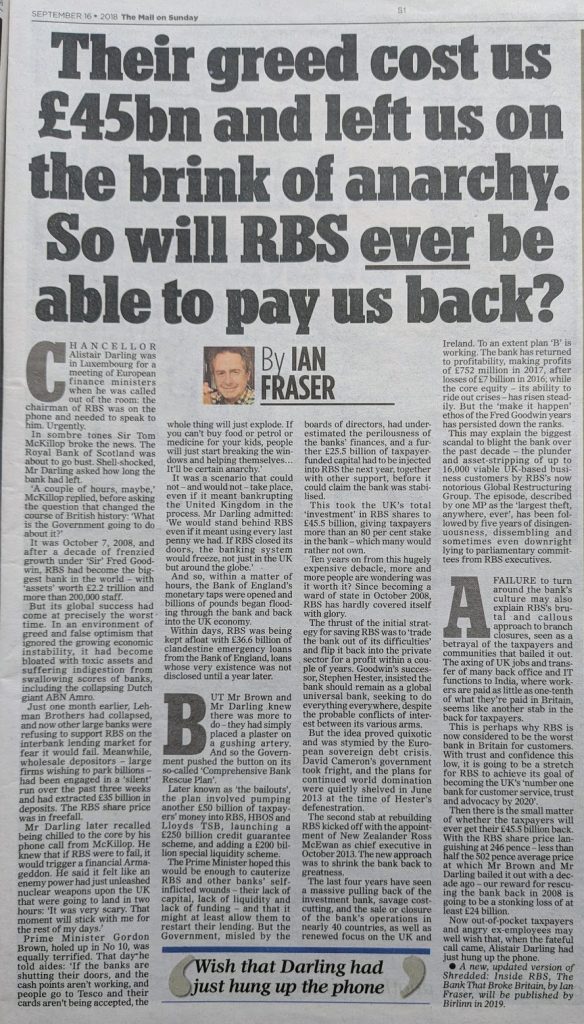
Article as published in the Scottish Mail on Sunday