

Photo Theo Ho (瑞丽江的河水) CC BY-SA 4.0
John Swinney, the finance secretary, has accused Lloyds Banking Group and Royal Bank of Scotland of abusing their dominant position in the Scottish banking market and of starving small and medium-sized businesses of access to finance.
Swinney has written to the chancellor, Alistair Darling, urging him to introduce new measures to ensure greater competition in the Scottish banking sector. Failure to do so risks harming Scotland’s chances of economic recovery, he warned.
He told the chancellor that Lloyds Banking Group, owner of Halifax Bank of Scotland since January 2009, and Royal Bank of Scotland have too dominant a share of the market and that SMEs are suffering because of inadequate access to finance.
On Thursday, the Scottish government published a survey on SME access to finance. This confirmed that the market is heavily concentrated. RBS or Lloyds Banking Group were found to have 75% of the market between them. Their market shares of the SME sector were 40% and 35% respectively.
The survey also found that, while the majority of Scottish firms are finding they can access the credit they need, it has become more expensive and the proportion being rejected for finance has risen sharply. The problem was particularly acute among micro and high-growth companies.
High-growth firms said they were having credit facilities withdrawn, or that finance was being reduced or increased in price on re-financing. The survey found the percentage of firms that have applied for funding but had it denied has surged from 13% in 2007 to almost 40%.
In an interview with the Sunday Times, Swinney said: “For our economy to recover strongly and sustainably, it is crucial that viable businesses are able to access the finance they need. We have called on banks to step up responsible lending – it is crucial they do so – but we are concerned over lack of competition in the SME finance market following the merger of HBOS with Lloyds TSB.”
“We need competition and greater choice in financial products for our businesses to be able to contribute to the growth and recovery of the economy. That is something the UK government must address.”
In his letter to Darling, Swinney said: “As you will be well aware, in addition to the OFT report, the Treasury Committee inquiry second report into the banking crisis was published on 1 May. Amongst other recommendations, the report called on the UK government to address the issue of competition concerns during the next two years. I would be grateful if you could advise on how the UK government intends to respond to this.”
A spokesman for RBS said the Scottish government’s research gave a misleading impression. He said it was based on interviews with 1001 SMEs completed between 15 March and 10 April. He said the bank has already lent £36m to Scottish companies under the Enterprise Finance Gurarantee Scheme introduced in January. He said RBS and NatWest’s acceptance rate on SME loans and overdrafts is 85%.
Donald Kerr, head of commercial banking at Bank of Scotland, part of Lloyds, said:“Since this research was carried out, Bank of Scotland has been actively lending to both new and existing customers. We remain dedicated to providing financial advice and solutions to all of our viable customers. We’re committed to helping Scottish businesses, not only to survive the recession, but to prosper.”
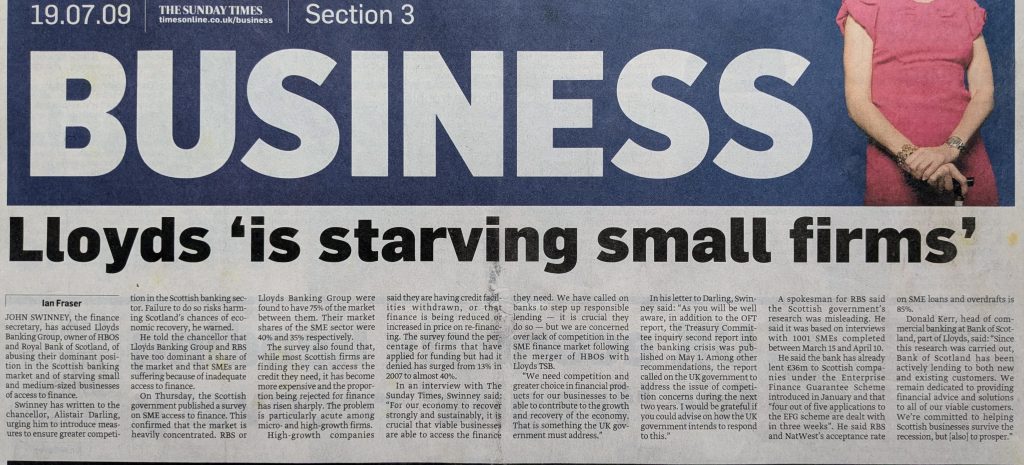
This article was published in The Sunday Times on 19 July 2009.
Article as published on front page of The Sunday Times business section on 19 July 2009