

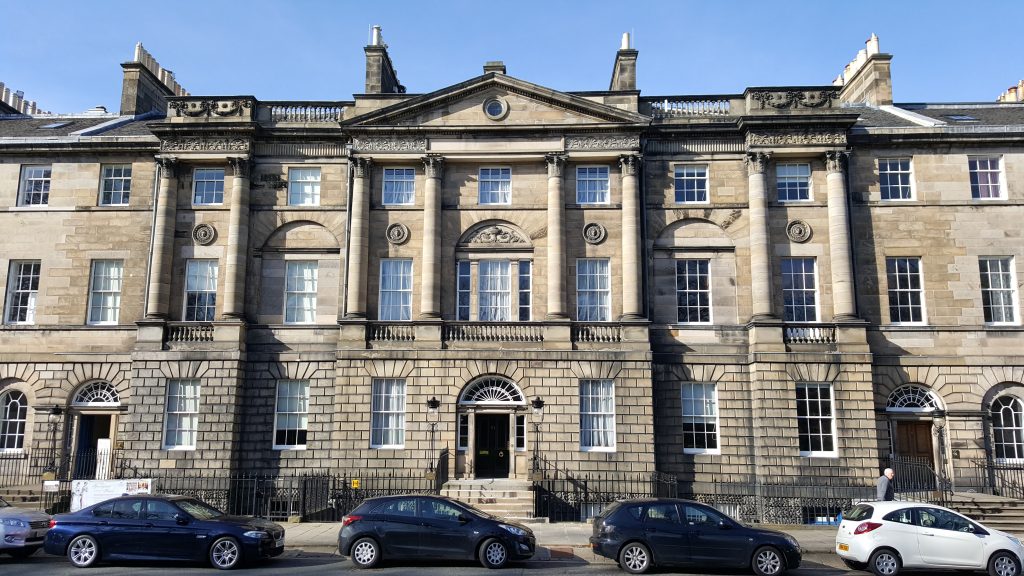
With an eye for Georgian town houses – and Ferraris – Walter Scott is a key figure in the renewal of part of Edinburgh’s New Town, finds Ian Fraser
THE biggest surprise as the nuclear physicist turned fund manager Walter Scott guides you round his new office on Charlotte Square is not the architecture. It is the impressive collection of scale model Ferraris that the 58-year-old fund manager has in his corner office over looking the square. (He has another — a real one — parked in the car park at the rear).
A passion for good design is clearly behind Scott’s latest project — the restoration of four adjoining town houses on the square. The facades of these buildings, which Scott bought for £6 milllion in 2001, were designed by the famous architect Robert Adam in 1791. They have been described by architectural historians as “one of the major achievements in European civic architecture of the period”.
But Charlotte Square slipped into decline when many of Scotland’s top professional firms — including lawyers Dundas & Wilson and Shepherd & Wedderburn, and fund managers Ivory & Sime, Baillie Gifford and Martin Currie — started to move out in the 1990s.
When Charlotte Square became déclassé
Believing the Georgian town houses inappropriate for modern working needs, the investment and law firms relocated to contemporary open-plan premises elsewhere in the capital. Most urgently needed more space, but Scott believes some used spurious arguments to justify their moves. “To say you couldn’t wire the building to get proper use of modern technology is more of an excuse than an argument. That’s just bollocks, it just costs a little bit of money to do it.”
Many of the buildings on the square were lying empty and some had been badly damaged internally.
Despite the presence of the official residence of the First Minister and moderator of the Kirk, other occupants were hard to find.
Scott first started thinking about the Charlotte Square’s future back in the late 1970s. At the time, he was a board director of the fund management group Ivory & Sime. But the company voted in 1980 to sell the two properties it owned and occupied on the square on a 50-year “sale and leaseback” agreement to NFU Mutual.
Thinking this irresponsible, Scott was dismayed. The only director on the Ivory & Sime board to vote against the proposals, he says: “They said a 50-year lease is the same as being a freeholder. But I say there can only be one owner.”
Scott’s current firm, of which he owns some three-quarters of the equity, has around £12 billion in assets under management.
Now Scott is on a mission to try and return Charlotte Square to its former glory. In addition to numbers 1-4, the former home of Ivory & Sime, he owns 15-17 and 44-46. And, he told the Sunday Herald, his appetite for further purchases has not abated.
At numbers 1-4, into which Walter Scott & Partners moved in January 2004 [while retaining its former premises at Millburn Tower, near Edinburgh Airport] it seems that little expense has been spared in the restoration.
Scott is an uncompromising conservationist. Floor joists, ceilings and parquet floors have all been replaced or repaired. The dormer windows —which he describes as “execrable additions” — in numbers 15-17 have been removed. Scott admits this was a non- commercial decision, as it reduces the lettable area. Perhaps unsurprisingly, his attempts to persuade other owners, such as the Kwik-Fit founder Sir Tom Farmer, to follow suit have proved abortive.
Scott says: “They don’t like the idea of reducing the lettable space and nor do they like the idea of having to pay to do so.
“In the commercial world it would not be a normal thing for people to do. However, I say, it creates a scarcity value and makes the houses even more beautiful. Now [that direct requests to the likes of Farmer have failed] we’re using moral pressure.”
In one of Ivory & Sime’s former buildings, an ornate ceiling crashed to the ground as heavy furniture was shifted from the floor above.

Scott hired the plasterers Fishers of Balerno, now known as The Gilmore Plastering Company, to reinstate the Robert Adam plaster ceilings and delicate cornice work in all of the 10 buildings he has acquired.
The firm’s Ted Fisher has worked flat out — often quite literally (a la Sistine ceiling)— on the project for the past five years. This year, he won the silver salver from Worshipful Company of Plasterers in the City of London in honour of his pains.
On one of the ceilings in 3 Charlotte Square, Ted Fisher, the fifth generation Fisher to work for the firm, was given free rein. Within an Adam-esque framework he created an impression of the four seasons incorporating medallions featuring the figure of Britannia and, in a more modern touch, a circle of maroon painted flowers.
Graham Fisher, Gilmore Plastering managing director, says: “Walter Scott is the best client we’ve ever had — not many people allow you to do that standard of work.”
In the upstairs boardroom in number 1 hangs a portrait of Scott’s namesake, the novelist Sir Walter Scott, by the portraitist Henry Raeburn. Scott says: “Angus Grossart phoned me up one day and said there is a portrait for sale with your name all over it.”
The painting was in the Fine Art Society in London and Scott bought it, and repatriated it. On another wall is a triptych portrait of Scott and his two co-founders Ian Clark and Marilyn Harrison — both of whom are still with the firm.
It is clear that another part of Scott’s dream is to recreate something of the buccaneering spirit of Ivory & Sime — which is widely seen as having evaporated following internecine feuding in the mid1980s — at Walter Scott & Partners, which he founded in 1983.
A portrait of the late Jimmy Gammell, Ivory & Sime’s guiding light, and father of Cairn Energy chief executive Bill Gammell, hangs in pride of place in the dealing room. Like Gammell, Scott believes the great architectural surroundings can inspire fund managers to make even better investment decisions.
But how can Scott’s unusual approach to conservation be summed up? It is perhaps best to leave it to the man himself.
As I leave, Scott paraphrases the famous slogan used to advertise Patek Philippe watches. He says: “You never actually own a house on Charlotte Square, you merely take care of it for the next generation.”
This article was published in the Sunday Herald on 28 August 2005. Read it on Herald Scotland.