
The unravelling of what’s become known as the “Scottish shambles” isn’t just a huge embarrassment for Nicola Sturgeon and the Scottish government. It also potentially wipes out a £10bn programme of investment in Scotland’s infrastructure and may sour relations between Edinburgh and Beijing for years to come.
The collapse of the agreement in August provides a vivid illustration of the pitfalls that governments and companies can fall into when seeking commercial relations with the People’s Republic of China, which overtook Japan to become the world’s second largest economy five years ago.
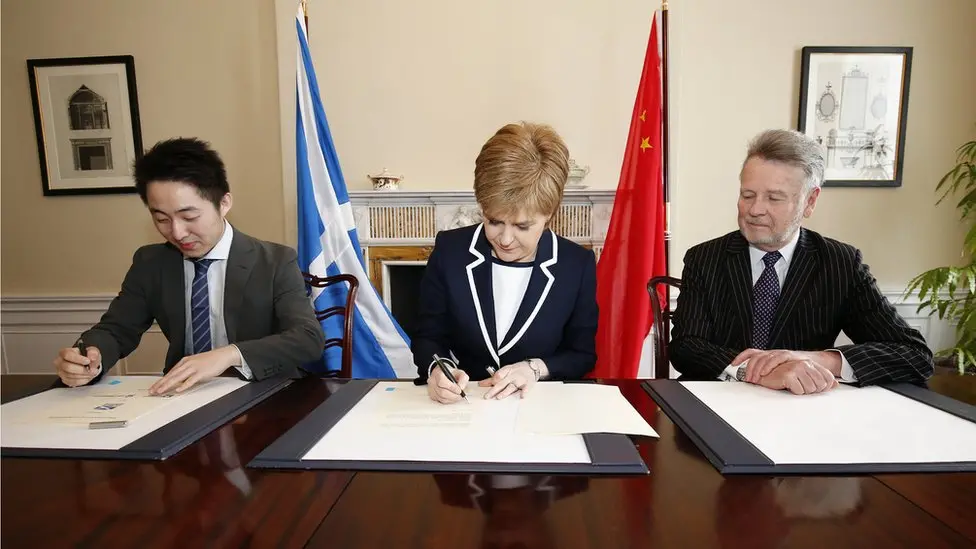
In March 2016, Sturgeon signed a Memorandum of Understanding (MoU) for a potential £10bn of inward investment into Scotland from two Chinese companies – privately-owned SinoFortone Group founded by London based but China-born Peter Zhang and the state-owned China Railway No. 3 Engineering Group.
The expectation was the two companies would jointly invest hundreds of millions in Scottish infrastructure — including transport, clean energy, and affordable housing. But there was a backlash against the deal over the fact the deal it never formally announced by the Scottish Government and only emerged thanks to overage in the Chinese media.
There were also concerns, amplified by opposition parties, that CR3’s parent company, China Railway Group Limited, had been blacklisted by Norway’s oil fund over allegations of “gross corruption” and that Amnesty International said it was “seriously concerned” over the CRG’s human rights record in Africa.
Scottish Labour’s finance spokesperson Jackie Baillie said: “Having signed a secret deal, the SNP have sought to mislead Scots about the details . This deal stinks and has done from the very beginning. It’s time for the SNP came clean and published all the documents relating to it, going back to when discussions first started.”
Lesley Batchelor, director general of the Institute of Export & International Trade, believes Sturgeon and her advisors committed a “howler” by not doing their homework.
Asked how the Scottish government could have sought to do business with a company whose parent was blacklisted over corruption fears and had a questionable track record on human rights, Batchelor said: “It’s really a question of doing your homework before you start signing things.”
“As far as the Scottish government is concerned, as a business person, I would have done a lot more due diligence on that,” said Batchelor. “They do have the benefit of support from what was UK Trade & Investment, which is now the Department for International Trade, there are people in country [China] who could have helped them on that, so I don’t really understand how this can have happened.”
“People do make mistakes, though it does seem incredible when you consider all the help and advice that a government such as the Scottish Government has access to. When it’s a government you do expect them to be ultra-careful… We do a lot of work with Scottish enterprise including training their staff, but this does sound like a real howler.”
Martin Gilbert, chief executive of Aberdeen Asset Management, which gained a licence to operate in China from the Chinese government last year, said: “When it comes to China, it’s important to engage and be constructive, but at the same time to tread carefully. Its potential is beyond doubt, but you need to be discerning and think long-term.”
He added: “China is the world’s second largest economy and may well overtake the US in the years to come. The opportunities within the country and its financial muscle to invest elsewhere in the world cannot be ignored. But in our experience there are no quick wins.”
Chinese trade is vital to Scotland and increasingly Chinese inward investment is too. In a five-year China plan published in 2012, the Scottish government made this clear when it said it was determined to build stronger economic ties with China. The five-year plan, put together when Alex Salmond was first minister, stated: “To facilitate inward investment, we will position Scotland as the ideal European base for Chinese companies with a focus on our pro-innovation business environment.”
At the time, the Scottish government said it would vaunt Scotland’s strengths in low-carbon renewable energy, innovation, air routes and investment finance. SDI has established four offices in mainland China – in Beijing, Shanghai, Shenzhen – as well as one in Hong Kong.
There are already plenty of Chinese companies with significant Scottish operations, including the state-owned oil company Petrochina, which entered Scotland in 2011 through a joint venture with Switzerland-based petrochemicals group INEOS. Today it has joint control of the Grangemouth oil refinery, formerly owned by BP.
It has not always worked well for Chinese investors in Scotland though. Beijing-based Sinopec acquired a 49 per cent stake in Talisman’s UK North Sea business, but the deal soured when the oil price collapsed. According to the energy expert, Jilles van den Beukel, “For Sinopec a $1.5 billion investment turned into an abandonment-related liability within three years.”
A partnership between Chinese battery technology specialist BYD [Build Your Dreams] and Falkirk-based bus builder Alexander Dennis, which is 55 per cent owned by investment funds of Brian Souter, that kicked off in October 2015, looks more promising, and there have been reports that BYD may make a £200 million bid for the whole of Alexander Dennis.
Together the two companies are equipping municipalities across the UK – including London and Liverpool – with fleets of zero-emission electric buses under the Enviro200EV marque. Unveiling the deal, Alexander Dennis and BYD predicted their partnership could see them make £2 billion worth of vehicles.
Chinese aviation giant HNA Group, which part-owns China’s fourth-largest airline Hainan Airlines, last year expressed an interest in taking over of Prestwick Airport, which the Scottish government nationalised in October 2013 but is eager to sell. HNA signed a memorandum of understanding with Prestwick in October 2015, allowing preliminary discussions to proceed. The Orkney-based European Marine Energy Centre and the University of Edinburgh have signed a memorandum of understanding with organisations based in the Qingdao area with a view to developing a marine energy test site in China.
In a recent deal, Chinese internet giant Tencent acquired a stake in the Scottish mapping business Sensewhere, in order to use its mapping solutions in Tencent Maps. Sensewhere will also be Tencent’s preferred vendor for location-based advertising services in China. Also huge numbers of Chinese students, including undergraduates and post-graduates, are studying at Scottish universities. And it is not all a one way flow. Last year Scotland’s food and drink sector exported £85 million of goods including Scotch whisky to the People’s Republic.
One of the biggest risks to doing business in China is that Chinese business partners will lack the same levels of corporate governance as their western suitors. After all, China is a country where pirating everything from smartphones to Hollinger t-shirts to Range Rover Evoques remains en vogue.
The theft of intellectual property remains a massive risk for anyone doing business there. Edinburgh based Pelamis Wave Power, a Scottish renewable energy company, had several laptops stolen in a burglary after it was visited by a 60-strong Chinese government delegation in 2011. A few years later, it noticed the launch of a strikingly similar project in China.
And, as Sturgeon has discovered to her cost, there are obvious risks when a government seeks to win business without doing proper due diligence from a regime like China’s which is renowned for having a poor record on human rights and the suppression of dissent.
Sturgeon’s predecessor, Alex Salmond found himself in an awkward position when the Dalai Lama, who Beijing considers to be an “enemy of the people”, paid a visit to Scotland in 2012. The Tibetan spiritual leader was received at the Scottish Parliament, and opposition leaders and human rights activists urged Salmond to also meet him. However Salmond kowtowed to the Chinese ambassador who urged him, in the strongest possible terms, not to meet the Nobel peace prize winner. Fearing a meeting would threaten Chinese investment, Salmond gave the Dalai Lama a wide berth and reassured Beijing the trip had nothing to do with his government.
Overall, Scotland is lagging where winning inward investment from China is concerned. Mark Harvey, senior partner at accountancy and consultancy giant Ernst & Young says that Scotland is underperforming the rest of the UK in this regard. “China is actively looking to invest internationally. However, at present China is favouring other parts of the UK over Scotland. The latest stooshie over “the Scottish shambles” is unlikely to help matters.
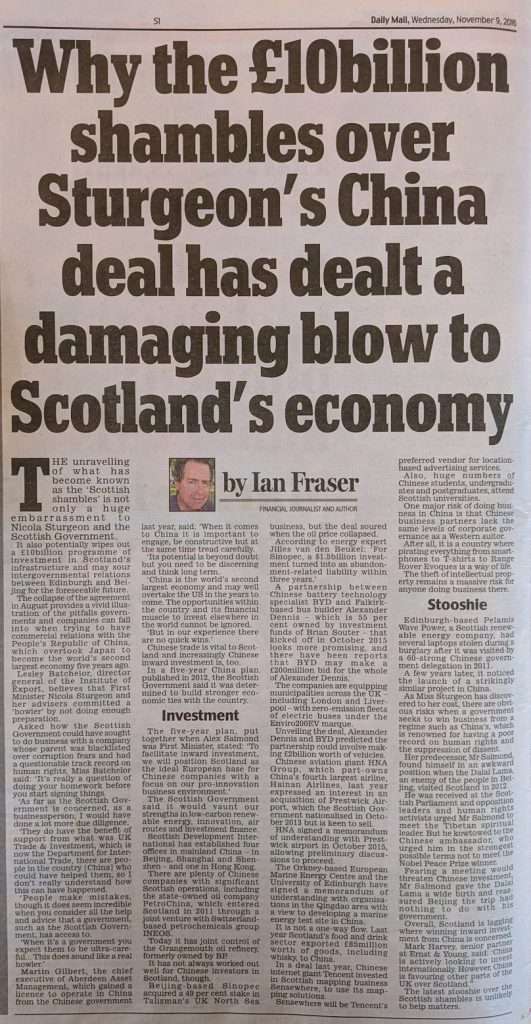
This comment piece was published in the Daily Mail on Wednesday 9 November 2016
Article as published in the Daily Mail