

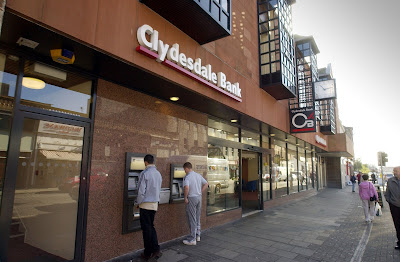
The last time a major bank announced a programme of sweeping branch closures the others followed suit. Will history repeat itself? Ian Fraser reports
FIVE years ago the UK’s high street banks declared an unofficial moratorium, deciding to put their branch closure programmes on hold.
HSBC, Royal Bank of Scotland/NatWest, Lloyds TSB and Barclays realised they could no longer risk the opprobrium that would be heaped on them if they continued to undermine local communities with further wholesale branch closures.
It was very different prior to April 2000. Until then, there had been thousands of branch closures across the land, to which the wine bars of Edinburgh’s George Street are a remarkable testament.
But on that day half a decade ago Barclays came out with the shock announcement it was closing 171 branches in one go. It was all the more insensitive given that it came while the bank was running a glitzy TV campaign extolling the virtues of being a “big bank”, featuring the likes of Sir Anthony Hopkins.
“It was one of the biggest PR disasters of all time, ” says Derek French, director of the Campaign for Community Banking Services. “Barclays was announcing two years worth of branch closures in one day.
“All the banks became worried about reputational risk, and while some like HSBC have persevered with closure programmes, they have preferred to close branches one at a time to avoid negative headlines. Most of the others put closure programmes on hold.”
It therefore came as a surprise when National Australia Bank last week broke ranks, declaring it would close 60 of 217 Clydesdale Bank branches and 40 Yorkshire Bank branches by late 2006.
In Scotland, Clydesdale only released details of 14 branch closures, with the remaining 46 to be unveiled in dribs and drabs. But already communities including Kincardine on Forth, Larbert, Dunlop in Ayrshire and Tayport in Fife are to be left without a bank.
Branches in Alexandria in Dunbartonshire, Anstruther and Inverkeithing in Fife, Calton, Bridgeton, Dennistoun, Govan and Pollokshields in Glasgow, Newmilns and Stewarton in Ayrshire and Strathaven in Lanarkshire were also singled out for closure.
The headlines were negative, with fears some Scottish communities could be tipped into a spiral of economic decline. There are also wider fears.
“With this move, NAB has given the green light to the rest of the industry, ” adds French. “There will be a domino effect as the other banks decide they can no longer afford to serve certain communities.” He referred to research from Professor Nigel Thrift, formerly of Bristol University which showed there is a domino effect when one bank shuts up shop in a community.
But he does not particularly blame Clydesdale. “They probably didn’t have any choice. It is happening against the backdrop of NAB’s failure to sell Clydesdale and Yorkshire last year. They had no choice other than to start trying to run those banks more cost-effectively.”
French says he is exasperated by UK banks and their swaggering culture. “The banks have become so arrogant, they are even arrogant with the government over basic bank accounts which they have tried to kill off. They are very adept at running rings around both us and the government.”
David Thorburn, chief operating officer at Clydesdale Bank, disputes the notion that his bank is “breaking ranks” and will unleash a wave of copycat closures. Thorburn says Bank of Ireland made 36 UK branch closures in 2003, Alliance & Leicester announced 46 in 2004 and HBOS closed 50 following its 2001 creation.
Thorburn says Clydesdale’s branch closure programme is a response to “demographic and economic change in Scotland” and that it is being matched by investment in other areas of Clydesdale’s network, including Financial Solutions Centres, ATMs and the internet.
“Customer usage patterns are changing and we decided we needed to reconfigure our network accordingly.” He says Clydesdale was striving to keep under-utilised branches open, for example by opening for the reduced hours of 9am-11am or 1pm-3pm, twice a week.
“But our research showed that, in one branch, no customers came in for the whole two hours it was open.” Thorburn also referred to the alliance Clydesdale formed with the Post Office last year.
“In most cases there is a Post Office within 200 yards of the branch that is closing.” “The arrangement is also likely to increase the chances of the Post Office surviving in those communities, because the footfall should increase.”
But Laurence Baxter, senior policy adviser at Which? says: “They should be exploring better options than that.
“The Post Office is already overburdened, and as more Post Office branches close, there will be an increasing strain on those that are left. It also has charging ATMs. It’s not really a viable alternative.” Baxter says shared “white label” branches a proposal put forward by the Campaign for Community Banking Services but rejected last week by the banks would have been a better solution.
He says: “It’s very disappointing that Clydesdale did not look at other options. Soon the only banks left will be in busy city centre locations, such as Leicester Square and Princes Street. That would be devastating for consumers and small businesses.”
This article was published in the Sunday Herald on 15 May 2005