

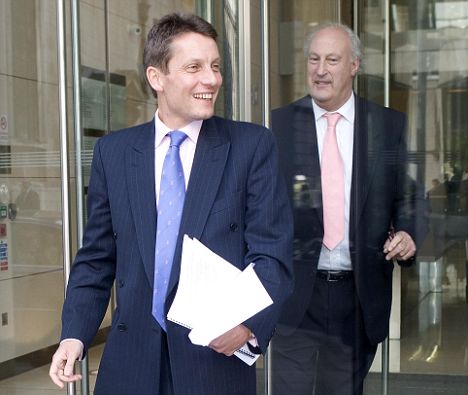
Why is Andy Hornby looking so pleased with himself?
Could it be that, in agreeing to a takeover of HBOS by Lloyds TSB last September, he had found a way of passing on a poisonous legacy onto a pair of credulous numpties, at the same time as finding a convenient escape route for himself?
Last September, Sir Victor Blank and Eric Daniels, the chairman and chief executive of Lloyds TSB, thought they had got the deal of a lifetime when they clinched their HBOS takeover.
Blinded by the unprecedented opportunity to recreate the oligopoly in British banking — which they owed to the intervention of prime minister Gordon Brown, who was desperate to avoid having to nationalise HBOS — and by greed, the pair suspended their critical faculties.
The dream has, unsurprisingly, turned very sour for Blank and Daniels.
After Friday 13th’s “shock” announcement that HBOS would declare losses of between £10bn and £11bn for 2008, it has become increasingly clear that Daniels and Blank were hoodwinked by the HBOS board, led by chairman Lord Dennis Stevenson.
It would be interesting, for example, to know what Lloyds was told by the HBOS board last September about what the Scottish bank might be expected to make (in terms of profits or losses) in the year to December 31 2008. Presumably it was a lot more than minus £10.8bn?
Justin Urquhart-Stewart, co-founder and marketing director of Seven Investment Management, described the situation rather well when speaking to Bloomberg last week. He said:
“It’s not that Eric Daniels is a bad person, but he and his colleagues were tempted by the opportunity. What they didn’t know was that in undertaking this shotgun marriage HBOS was already pregnant with the spawn of Satan in terms of the losses coming through. It’s a hideous situation.”
If this is true, shouldn’t Stevenson, Hornby and particularly the bank’s ex-head of corporate lending, Peter Cummings, have been rather more open and honest when discussing the takeover with Lloyds — particularly about the nature of their past and present business partners?
The motivations were clearly all wrong at HBOS, a bank I have described as having had “an integrity bypass” in about 2002-03. One senior banker recently told me that: “When people like Peter Cummings are handed £1.5m bonuses, they start to go off the rails. It gives them an incentive if not to bend the rules, then certainly to stretch the elastic.”
The problem was compounded by Cummings’ sycophancy towards playboy plutocrats such as Sir Philip Green, Nick Leslau, the Reuben Brothers and Vincent and Robert Tchenguiz. Cummings became so close to some of these guys — attending their childrens’ barmitzvahs and other ostentatious parties — he appears to have suspended his critical faculties. Star-struck, the boy from Dunbarton became their lapdog.
The whole thing seem to have got started after Cummings got lucky with a loan to the retail tycoon Philip Green in 2002. Cummings bankrolled Green’s £770m acquisition of the retail group Arcardia, demanding an 8% stake in the business.
It worked out so well that the HBOS board later gave him free rein to lavish massive loans on other favoured tycoons, seemingly without any of the usual checks and balances. As long as the corporate division continued to make money, they didn’t bother to ask him how.
Under Cummings — whose grip over HBOS’s corporate arm tightened after the departure of his ex-boss George Mitchell in December 2005 — loans and advances to corporate borrowers soared from £73.2bn in 2004 to £116.9bn by mid-2008.
Rather than rely on “due diligence” by one of the Big Four accounting firms or on believing the smooth words of the likes of Stevenson and Hornby about the state HBOS was in, Daniels and Blank ought to have done their own research.
The stitch-up, coupled with HBOS’s profligacy, has already cost UK taxpayers an estimated £13 billion. The original £17bn of our money that Brown invested in Lloyds/HBOS is now plummeted in value to £4bn, according to BNY Mellon Asset Management. Yet we are going to have to put in a whole lot more. In the next few days Lloyds Banking Group will be taking out a massive and expensive policy with the government’s asset protection scheme (APS).
To avert this catastrophe, Blank and Daniels could, for example, have picked up the phone to me or my former colleague on the Sunday Herald, Kenny Kemp. We would happily have provided them with information on egregious goings on at Bank of Scotland Corporate from 2003 onwards.
We could, for example, have told them about a formal complaint made to the FSA about the way in which the bank was already abusing joint ventures and opaque off-balance-sheet vehicles, often linked to the so-called “12 Apostles” (a cosy coterie of loyal business partners, who are known to include Kevin McCabe of Scarborough Holdings and Sheffield United), to mask bad debts arising from failed property ventures. This sort of thing was rife at the bank between 2003 and 2006.
That particular complaint was, naturally, swept under the carpet by the ‘Fundamentally Supine Authority’ (FSA) — and the presence of Sir James Crosby, the then chief executive of HBOS, on the regulator’s board had nout to do with that.
HBOS’s problems are not confined to its corporate lending business. The bank has also stored up problems for the future on the retail side. Ratings agency Fitch recently revealed HBOS’s mortgage portfolio “contains around £60 billion of buy-to-let and self-cert mortgages that, in Fitch’s opinion, are likely to deteriorate faster and more severely than its prime book.
These include the notorious “liar loans” highlighted by Michael Robinson on the BBC Money Programme in October 2003. The HBOS subsidiary Birmingham Midshires was pushing such loans to anyone unable to afford a conventional mortgage and basically encouraging its own customers to defraud it on a massive scale.
If these allegations are true, HBOS would have been committing a criminal offence. The widespead abuse of such mortgages played a massive part inflating the UK’s house price bubble.
And remember who was head of retail at HBOS at the time — yes, Mr. Andy Hornby.
In their quest for scale, Blank and Daniels have saddled themselves and Lloyds’ shareholders with a calamitous franchise that will prove their undoing. Their decision to proceed with the deal last September will, at the very least, cost them their jobs. It could cost them a whole lot more, and might even spell the end of Lloyds.
In an alternative take on the Lloyds/HBOS debacle, have a read of Dominic Lawson in The Independent. He wrote: “The more cynical among Lloyds TSB shareholders see the deal as a cunning way for a Scottish Prime Minister to get largely English private investors to pay the costs of more gargantuan financial folly from North of the Border.”
Some truth in that too, perhaps?
This blog post was published on 23 February 2009
Pingback: Ian Fraser - Business and Financial Journalist based in the United Kingdom Ian Fraser » Blog Archive » A new player emerges: Fred’s crazy £200m of handouts to sports celebs
Pingback: Stocks and Bonds » Blog Archive » Guyana-Born Cricketer Denies Drug Smuggling From St Lucia
Pingback: Ian Fraser - Business and Financial Journalist Ian Fraser » Blog Archive » What’s with all these open letters?
Pingback: Ian Fraser - Business and Financial Journalist Ian Fraser » Blog Archive » Peter Cummings should be stripped of his £344k annual pension