

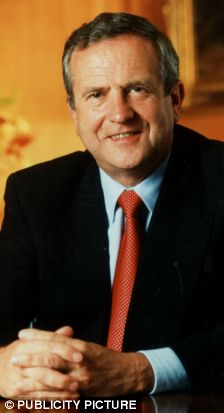
He is renowned for his brusque, uncompromising style. But will this be the undoing of Sir George Mathewson, the Royal Bank of Scotland’s new chairman? Ian Fraser reports
AN iconoclast and a “toughie” whose willingness to defy banking tradition has already paid off handsomely, Sir George Mathewson will get his just reward in a few days’ time.
Mathewson, who has transformed a struggling regional player into the seventh-largest company in the FTSE 100 through the £21 billion takeover of National Westminster Bank last year, steps up to the role of chairman of the enlarged bank at the annual general meeting on April 11.
This represents the icing on the cake of a career which has spanned lecturing in electronic engineering at St Andrews University, venture capitalism for 3i in the Granite City, and leading the Scottish Development Agency from Glasgow for most of the 1980s.
A director of the Royal Bank of Scotland since 1987, Mathewson was its chief executive from 1992 until he handed over to his anointed heir Fred “the Shred” Goodwin in March 2000.
With NatWest in the bag, Mathewson’s dream of assuming the chairmanship of a genuine UK player — which just happens to be based in Edinburgh — is about to materialise.
But being Royal Bank of Scotland’s chairman is going to require different skills. Some business observers believe Mathewson, who turns 61 next month, is going to have to temper his brusque style to suit his more elevated role.
Nobody could ever accuse this rugby enthusiast of being schooled in the gentlemanly virtues. He rarely shirks from speaking his mind and almost seems to relish his reputation as a blunt-spoken Scot who delights in making derogatory remarks to investment analysts.
Mathewson’s unorthodox style stood him in reasonably good stead while he was Royal Bank of Scotland’s chief executive. But some observers are now hoping some of the tact and diplomacy for which the bank’s outgoing chairman Lord (George) Younger is famous might rub off on him.
The omens are not good.
Last week, when Mathewson sought to downplay the £2.54 million special bonuses awarded to himself and three fellow directors of Royal Bank of Scotland for the successful takeover of NatWest, he dropped a clanger.
In an interview with Simon Targett of the Financial Times, Mathewson claimed his £759,000 special bonus, together with those paid to Fred Goodwin (£814,000), Iain Robertson (£773,000), and Norman McLuskie (£197,000) were so insignificant they ‘wouldn’t have given you bragging power in a Soho wine bar’.
It was a typical off-the-cuff put down, which no doubt Mathewson found amusing at the time and is reflective of his disdain for fund managers who fail to match their index but still enjoy massive bonuses. But he now must be wishing he had picked his words more carefully.
“George is not clever at public relations. It was an ill-considered remark given the context,” said the head of one Edinburgh investment bank. “He really ought to have thought before he opened his mouth.”
At a time when the Royal Bank of Scotland is shedding 18,000 jobs, there’s no doubt it was insensitive. Many of the dispossessed — as well as account holders and business customers who are struggling to make ends meet — will have considerably less to brag about when they go down to their local boozers.
Paradoxically, Mathewson is right about that Soho wine bar. The £197,000 to £814,000 bonuses related to the successful acquisition of NatWest do genuinely pale into insignificance when compared to the sums routinely handed out to investment bankers and analysts at organisations such as Goldman Sachs and Merrill Lynch.
But this doesn’t excuse the remark. Younger, a former Tory defence and Scottish Secretary, would never have made such a statement.
The scion of a famous brewing dynasty and a brigadier in the Honourable Company of Archers (the Queen’s bodyguard in Scotland), Younger is one of Scotland’s most clubbable senior rain-makers. He has been described as a “warm cuddly individual” by those who know him well.
Chairman of the Royal Bank of Scotland since 1991, Younger is credited for smoothing the path of the takeover of NatWest to behind the scenes. He used finely honed diplomatic skills to lead a charm offensive towards NatWest’s former chairman Sir David Rowland — who at first set himself dead against a deal with either of his Scottish adversaries.
During the bidding war with Bank of Scotland, Younger was also working closely with advisors at Goldman Sachs, Merrill Lynch, Credit Lyonnais and Warburg Dillon Read, assuaging egos and ensuring “they were happy and doing a good job”. He may well have resented their pay packets especially when his bank was having to pay through the nose for their support — but he certainly didn’t slag them off in public.
One Edinburgh-based businessman said: “Younger and Mathewson are polar opposites. One of the key differences is that Mathewson has never courted friendship.”
That’s all very well, but surely as chairman of a leading UK plc, he is going to need some friends?
Mathewson’s remarkable brusqueness has already led to an uneasy relationship with the City of London. This appeared to take a turn for the better during the NatWest bid when, despite an interminable round of presentations, he managed to keep his cool and remained remarkably low key.
This was in sharp contrast to rival bidder Peter Burt, chief executive of Bank of Scotland, who got caught up in an slagging match with NatWest chairman Rowland.
With his “bragging power” remarks, Mathewson has set the clock back. He may well think the bonuses are well-earned. After all he and the three co-directors devoted eight months of their lives to securing NatWest and the Royal Bank share price has been buoyant since — notwithstanding the recent slide in global stock markets.
He has said: “We don’t believe we have anything to be ashamed of. Our biggest shareholders are quite happy about it because we have done quite well for them.”
But the National Association of Pension Funds’ worry is that, as with with Chris Gent’s £10m bonus on taking over Germany’s Mannesmann, the Royal Bank bonuses were issued to directors for a transaction before its true merits had really been seen.
Despite some backtracking by both sides last week, the pensions organisation is still asking members to vote BT chairman Sir Iain Vallance and Sir Angus Grossart of Noble Grossart, both members of Royal Bank of Scotland’s remuneration committee, off its board at the AGM.
Mathewson would do well to remember the words of Lord Younger in February 2000. The outgoing chairman then pointed out that making a takeover was easy compared to fully integrating two organisations and creating sustainable value from their marriage.
“I am more daunted than most staff at the Royal Bank by the task ahead,” Younger told the Sunday Herald in February 2000. At a party to celebrate the successful conclusion of the takeover, Younger told employees: “What you’ve just done is the easy bit.” He later added: “People blanched a bit at that.”
One Edinburgh-based financier said: “The key test is whether they will deliver what they have said they will deliver. They may be ahead of target but it is not yet proven.”
Having made some enemies in the Square Mile with his arrogant style and withering disregard for City scribblers, Mathewson now probably needs to watch his step. His minders are surely aware that some of those foes are already sharpening their knives.
This article was published in the Sunday Herald on 1 April 2001