

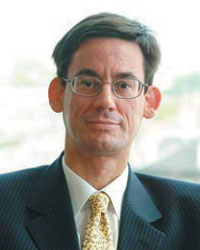
Photo: Euromoney
Baillie Gifford has pulled in $7bn in new business over the past three years, cushioning the partnership from equity market falls
With the stock market continuing its downward march, Alex Callander could not have picked a more difficult time to take the reins at independent fund manager Baillie Gifford.
However, the Edinburgh-based partnership did not have any obvious internal problems as Callander, a 43-year-old Cambridge maths graduate, stepped up to the chief executive officer role on the retirement of Gavin Gemmell in May 2001.
Poorly performing equities present most fund management firms with a severe headache as they struggle to find ways of marrying a high-cost base with decreasing revenues.
A lot of industry players had naively assumed the bull market of the 1990s was going to continue indefinitely and had based their business plans on the expectation that share prices (and hence their own revenues) would continue to rise by around 20% per annum. It was an assumption that has proved crippling for many.
But Baillie Gifford, a firm which is renowned for its low-profile, steady-as-she-goes approach in the industry and focus on discovering global growth opportunities, did not delude itself to the extent of some of its peers.
Baillie Gifford and its 415-strong team last week pulled off what must be seen as an extraordinary coup. Despite the industry carnage all around, it managed to raise its assets under management to a record high of more than £24 billion for the first time in the firm’s 95-year history. The magic figure blipped up on employees’ intranet screens last Tuesday morning.
With his trademark understatement, Callander says this is “pleasing”. True to form, he is unwilling to take much of the glory himself. “Baillie Gifford is very much a team place and it’s not really down to any one individual.”
The firm’s assets under management sank as low as £19bn on December 31, 2002. But a combination of this summer’s minor equity rally and a strong inflow of new business from UK and overseas clients has enabled it to add £5bn in the past seven-and-a- half months.
Since January 2000, Baillie Gifford has reeled in net new business of £7bn, with the peak being 2002 when £2.5bn of net new business flooded through its doors. The Rutland Square-based firm pulled in a further £1.5bn in the first half of 2003, just under half from overseas clients, and the rest from the UK.
“That helped cushion us from the falls in funds under management caused by weak markets and has helped push them back up again.”
Callander is expecting net inflows in the second half of this year but cannot predict their extent. But, with a healthy dose of realism, he adds: “Just about everything is going well for us at the moment — so this is probably towards the peak of the new business cycle.”
The firm’s previous high point came as markets peaked in March 2000, when its total funds under management reached £23bn.
Callander now believes the key challenge for the Edinburgh-based firm — which also has sales outposts in London and New York — is managing its growth. Before taking over as chief executive, he spent nine weeks on the advanced management programme at Harvard Business School, still perhaps the world’s most prestigious business learning seat.
Callander was particularly influenced by a case study for US sunglasses manufacturer Serengeti Eyewear, which he says highlighted the need to “manage growth” and the need to formalise procedures which may previously have been handled informally.
He says: “If you go too fast [in formalising internal procedures] things become bureaucratic and stultify; and if you go too slowly, quite honestly, then they just become chaotic.”
Callander recalls how something along these lines occurred in the mid-1980s at the height of the Thatcher privatisation boom, when share trading volumes on the London Stock Exchange expanded enormously and settlement systems struggled to cope.
At that time, he says, Baillie Gifford was “running around in ever-decreasing circles and fire fighting. Nothing horrendous went wrong but you want to avoid that if you can.”
To prevent a repeat performance, Baillie Gifford took the decision to periodically close certain investment sectors to new business. Its emerging market products are currently closed and its mainstream UK pension products were closed for the second half of 2001. Callander said it also provoked the firm to boost staffing levels.
The biggest turning point in Baillie Gifford’s history came in the late 1970s when the firm decided to diversify away from its previous core business of managing investment trusts. This followed the loss of the Edinburgh & Dundee investment trust in 1978.
Callander, who joined the company straight after university in 1982, says: “That was the catalyst to making the partners think about the business and deciding how to grow and diversify it.”
While Baillie Gifford still manages six investment trusts which have total assets of £1.8bn and has recently attempted to win mandates to manage a couple more, these relative dinosaurs of the investment world now account for less than 10% of its total assets.
Instead, since the early 1980s, it has been focused on winning and managing pension funds for UK and overseas clients.
“Now you can say that we are a global fund manager that happens to be based in Scotland, rather than a local investment trust player, which is what we were in the beginning.”
Among its clients Baillie Gifford now counts some of the largest and most sophisticated investors in the world – including five of the world’s 15 largest pension funds. These include The State of California’s Calpers scheme and The State of New York Pension Fund.
Callander says: “In each of our main markets — North America, Europe and Japan — we’ve got at least one of the top three.”
But how does Baillie Gifford consistently manage to get onto the roster for such leviathans of the investment world? Callander believes that it all boils down to a combination of investment outperformance and good client service.
“We are active investors, we are bottom up, and we have a bias towards companies that can grow their earnings and dividends, rather than companies that are just cheap.
“What we try to do is to focus our investment managers as much as possible on deciding which stocks to buy and sell, and backing their judgements. And we minimise other distractions. At the same time we try to give our clients a very high level of service.”
Callander believes that being a partnership, effectively owned by its 24 most senior staff, is conducive towards this.
He says: “The senior people own the business, and the middle-ranking people hope to own the business. This means that if you see something that you don’t quite like, your first reaction is to try and improve it rather than go off and get a job elsewhere.
“That leads to great continuity of personnel and stability — which is good from the point of view of interaction in the office and from the point of view of the clients.
Most of the partners in the institutional clients department — including Ross Lidstone, Leslie Robb, Nigel Morecroft and John Carson – have joined from the outside over the past two decades.
However, Baillie Gifford generally prefers to promote from within. This autumn it will take on seven graduate trainees —five in fund management and two in other fields. Like Callander himself, two-thirds of its 24 partners joined through its graduate trainee programme.
Callander believes the structure makes people feel more secure and self-confident. He says: “They are more prepared to say what they think, rather than what they think their boss wants them to say. You therefore get a more open debate and less politicking. In the long run that makes for better decision-making and improves your chances of out performance.
“The other aspect of the partnership culture is that we’re all in it together — you all have unlimited liability, which helps foster a team approach.”
One spin-off of Callander’s spell at Harvard was that the firm felt the need to clarify and internally disseminate its own strategy. In late 2001 it put together a one-page flow chart that includes a certain number of core business goals. “As you grow and you’ve got more people joining it helps if you’ve got it written down,” explains Callander.
Key phrases on the flow chart include: Focus our investors [investment managers] and reduce distractions; Back our judgements; Put clients’ interests first; Keep our business simple; Small number of large clients; and, perhaps most importantly, No corporate activity.
Callander explains that dealmaking, in the mode practised by Aberdeen Asset Management’s Martin Gilbert, is “not simple in itself, is an immediate distraction and increases politics, with people wondering where they are in the pecking order”.
Nor does Callander believe that Baillie Gifford’s partners are likely to be tempted to increase their already considerable wealth by selling the firm.
“I am sure the vast majority of us believe that we basically hold this business in trust and there is no wish to sell. We are committed to maintaining our independence and to maintaining our partnership culture.”
Catch-up
Alex Callander, 43, is perhaps one of the least flamboyant characters in the world of fund management. But he has presided over an extraordinary surge in new business at Edinburgh-based Baillie Gifford. Last week the firm’s funds under management broke through the £24bn barrier for the first time.
Copyright 2003 SMG Sunday Newspapers Ltd.
This article was published in the Sunday Herald on 24 August 2003