

To the Royal Bank of Scotland’s employees, and indeed to many other inhabitants of these islands, it seems the ultimate betrayal.
Nine years ago, RBS would have ceased to exist had it not been for the generosity of the British taxpayer who came to its rescue with a £45.5 billion bailout plus an array of other state-support mechanisms.
One might have thought this would have caused the people at the top of RBS and its 73 per cent shareholder, H.M. Treasury, to feel some sense of obligation to their home country and to those who had saved the bank from oblivion.
But, despite the bank’s decision to axe most of its international network and refocus its activities on the UK and Irish markets, as well at its avowed intention to become the “UK’s number one bank for customer service, trust and advocacy by 2020”, it has in recent years, effectively, been kicking its rescuers in the teeth.
Not only has RBS closed large numbers of branches around the UK, depriving some of its neediest customers of essential banking services, it has also nearly halved its UK workforce to 57,300 since its own near extinction – with more than ten thousand of those jobs believed to have been transferred to India, where it has been able to recruit people to do the same things on around one-third of the pay.
Rather than prioritise the preservation of jobs, and the development of vital skills for the new digital era on its home turf, state-rescued RBS has opted to cull many of its more experienced staff and offshore their work – or “migrate” in the corporate jargon – to its rapidly growing “global hubs” in the Indian cities of Mumbai, Delhi, Chennai, Gurgaon and Bangalore and, to a lesser extent in Warsaw, Poland.
As part of a major recruitment drive in India, the bank is effectively draping itself in a promotional sari, practically characterising itself as an Indian institution (it uses the RBS acronym there, not Royal Bank of Scotland) and giving the impression the working day is so relaxed staff can fit in innumerable games of table-tennis, chess and snooker.
It’s part of a short-sighted and desperate attempt by the bank’s management, currently led by chief executive Ross McEwan, to restore RBS to profitability but it has little regard to the long term or even to risk management and controls.
For a start Indian salaries are rising, and the bank will one day find the cost advantages of doing back office work there is wiped out. The main focus of the “offshoring” to date has been on “back office” jobs, some of which involve menial tasks in areas like information technology, software development and loan processing.
However, as with the other western banks that are prioritising offshoring to India, RBS is now also starting to migrate higher-end functions in financial crime checks and anti-money laundering.
RBS’s total staff in India has grown to an estimated 12,500 – more than the 11,000 the bank currently employs in Scotland.
In a recent couthy, quite sentimental and patriotic TV commercial, aimed at a Scottish audience, the bank tracked the journey of a £10 note the bank claimed it was the “Royal Bank FOR Scotland”.
Well employees who have seen their jobs melt away into the Indian heat, customers who have been left without a branch and business customers who claim their firms were trashed by the bank’s notorious global restructuring group are wondering whether this is just hollow words.
Indeed they are wondering whether the bank actually has any loyalty to Scotland at all.
This article was published in the Mail on Sunday on 10 September 2017, linked to a front page splash by Lorraine Kelly headlined “MPs probe RBS over UK jobs switched to India”.
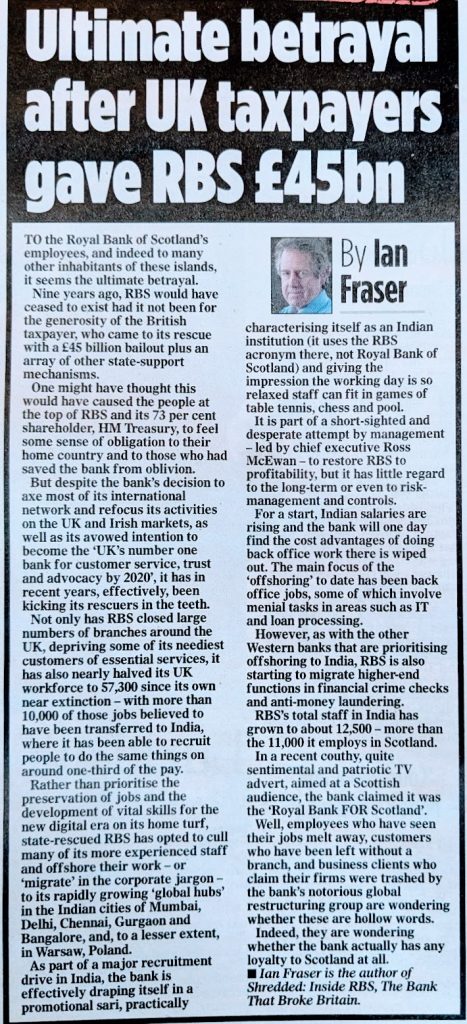
The comment piece as it appeared in the Scottish Mail on Sunday