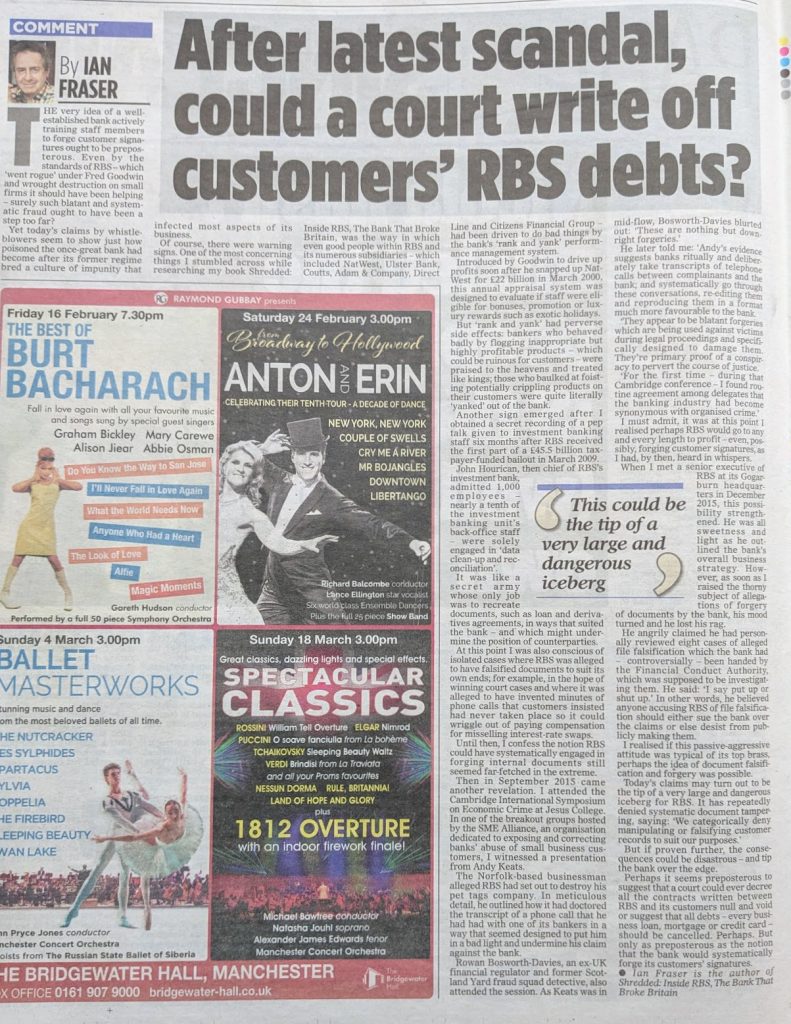


THE very idea of an established bank actively training staff members to forge customer signatures ought to be preposterous.
Even by the standards of RBS — which “went rogue” under former chief executive Fred Goodwin and went on to wreak destruction on small firms it should have been helping — surely such blatant and systematic fraud ought to have been a step too far?
Yet today’s claims by whistleblowers seem to show just how poisoned the once-great bank had become after its former regime bred a culture of impunity that infected almost every aspect of its business.
Of course, there were warning signs. One of the concerning things I stumbled across when researching my book ‘Shredded: Inside RBS The Bank That Broke Britain,’ was the way in which even good people within RBS and its subsidiaries — which included NatWest, Ulster Bank, Coutts, Adam & Co, Direct Line and Citizens Financial — were driven to do bad things by the bank’s “rank and yank” performance management system.
Introduced by Goodwin to drive up profits soon after he snapped up NatWest for £22 billion in March 2000, this annual appraisal system was designed to evaluate whether staff were eligible for bonuses, promotion, or luxury rewards like exotic holidays.
But “rank and yank” had perverse side effects: bankers who behaved badly by flogging inappropriate but highly profitable products, which might prove ruinous for customers, were praised to the heavens and treated like kings; meanwhile those who baulked at foisting potentially crippling products on their customers were quite literally “yanked” out of the bank.
Another red flag – which I also covered in Shredded – emerged after I obtained a secret recording a pep talk given to investment banking staff six months after the bank received the first part of a £45.5 billion taxpayer-funded bailout in March 2009.
In a motivational speech, the then chief of RBS’s investment bank, John Hourican, admitted that the bank had 1,000 employees – nearly one-tenth of the investment banking unit’s back-office staff – solely engaged in “data clean-up and reconciliation”.
It appeared that the bank had a secret army whose job was to recreate documents, such as loan and derivatives agreements, in ways that suited the bank, and which might undermine the position of clients and other counterparties.
At this point I was also conscious of isolated cases where RBS was alleged to have falsified documents to suit its own ends, for example in the hope of winning court cases, and where it was alleged to have invented minutes of phone-calls that customers insisted had never taken place so it could wriggle out of paying compensation for the misselling of interest-rate swaps.
But until that point, the notion that RBS would have systematically engaged in forging internal documents still seemed far fetched.
Then in September 2015, I attended the 33rd Cambridge International Symposium on Economic Crime at Jesus College, Cambridge. In a breakout group hosted by the SME Alliance, an organisation dedicated to exposing and correcting banks’ abuse of small business customers, I witnessed a presentation from Andy Keats.
A Norfolk based businessman, he alleged that RBS had set out to destroy his pet-tags company. In meticulous detail, he outlined how RBS had doctored the transcript of a phone call that he had had with one of its bankers in a way that seemed designed to put him in a bad light and undermine his claim against the bank.
Rowan Bosworth-Davies, a former UK financial regulator and former Scotland Yard fraud squad detective, also attended the session. As Keats was in mid flow, Bosworth-Davies blurted out: “These are nothing but downright forgeries, and these people have uttered them’.
Bosworth-Davies later told me: “Andy’s evidence suggests that banks ritually and deliberately take transcripts of telephone calls between complainants and the bank, and systematically go through these conversations, re-editing them and reproducing them in a format which is much more favourable to the bank.
“They appear to be blatant forgeries which are being used against victims during the course of legal proceedings and specifically designed to damage them. They’re primary proof of a conspiracy to pervert the course of justice. For the first time – during that Cambridge conference – I found routine agreement among delegates that the banking industry had become synonymous with organised crime.”
It was then that I realised that, perhaps, RBS was prepared to go to almost any length to profit — even, possibly, forging customers’ signatures, as I had, by then, heard in whispers.
And when I met with a senior executive at RBS at its Gogarburn headquarters in December 2015, this possibility strengthened. He was all sweetness and light as he outlined the bank’s overall strategy. However, as soon as I raised the thorny subject of allegations of forgery of documents by the bank, his mood turned and he lost his rag.
He angrily claimed that he had personally reviewed eight cases of alleged file falsification which the bank had – controversially – been handed by the Financial Conduct Authority which was supposed to be investigating them. He said: “I say put up or shut up”. In other words, he believed that anyone accusing RBS of file falsification should either sue the bank over the claims, or desist form publicly making them.
I realised if this passive-aggressive attitude is typical of its top brass, perhaps the idea of document falsification and forgery isn’t so fanciful after all.
Today’s astounding claims may turn out to be the tip of a large and dangerous iceberg for RBS. For the record RBS has repeatedly denied systematic document tampering at the bank, adding: “We categorically deny manipulating or falsifying customer records to suit our purposes.” But if proven further, the consequences could be disastrous, and tip the bank over the edge.
Perhaps it’s preposterous to suggest that a court could ever decree all the contracts written between RBS and its customers null and void or suggest that all debts — every business loan, mortgage or credit card debt — should be cancelled. Perhaps. But such a jubilee is only as preposterous as the notion that a bank would systematically forge its customers’ signatures.
Further reading on the signature forgery scandal at Royal Bank of Scotland / NatWest from the Transparency Taskforce. National Crime Agency and Bank Signature Forgeries
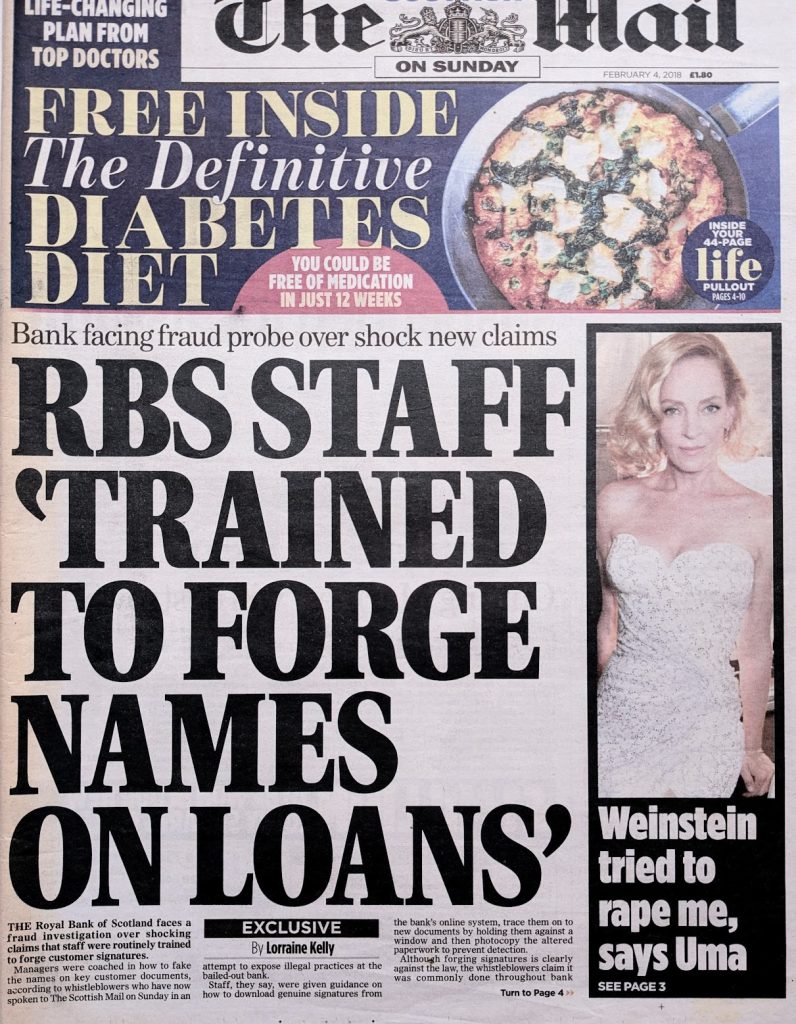
This comment piece was published in the Mail on Sunday (Scottish edition) on 4 February 2018. It accompanied Lorraine Kelly’s front page exclusive, which was headlined “RBS TRAINED STAFF TO FORGE NAMES ON LOANS”.