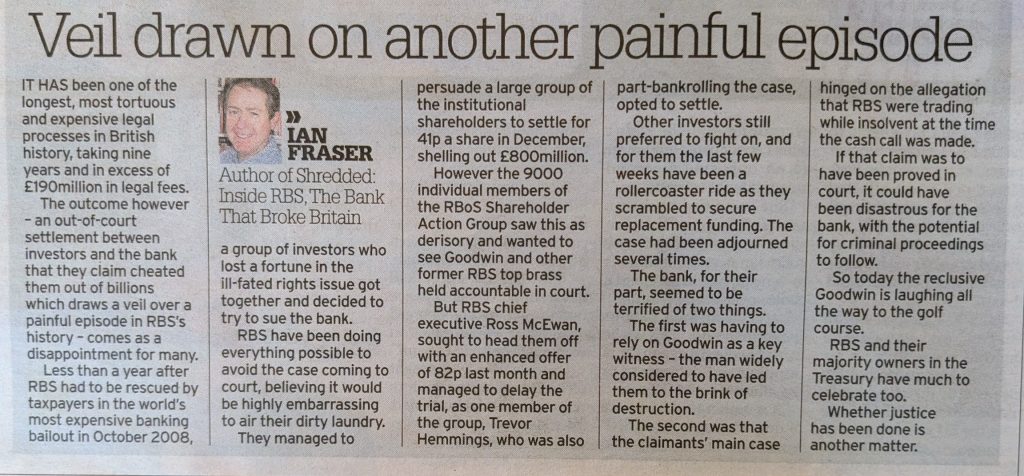


It has been one of the longest, most tortuous and expensive legal processes in British history, taking nine years and in excess of £190 million in legal fees. The outcome however – an out-of-court settlement between investors and the bank that they claim cheated them out of billions which draws a veil over a particularly painful episode in RBS;s history – comes as a disappointment for many.
Less than a year after RBS collapsed and needed to be rescued by taxpayers in the world’s most expensive banking bailout in October 2008, a group of investors who lost a fortune in the bank’s ill-fated rights issue of April 2008 got together and decided to try and sue the bank for allegedly duping them out of their cash. The investors accused RBS of putting together a false or misleading prospectus – a document that was rubber-stamped by City of London firms Goldman Sachs, Merrill Lynch, UBS, Linklaters and Deloitte and issued on 30 April 2008.
The document gave a rosy view of RBS’s prospects and claimed that, once the bank had completed the fund raising, and with Amsterdam-based bank ABN Amro under its belt, it was poised for growth and would have sufficient working capital to survive for another 12 months. RBS top brass including chief executive Fred Goodwin went on to plead with investors and coerce and bully colleagues inside the bank, into putting their money into the newly minted shares.
However, only a few months after they handed over their cash, RBS was dead in the water and, effectively, bust. Shares the bank and its adviers were touting as a bargain at £2 each had collapsed in value to less than 10 pence and RBS group needed a £45.5bn taxpayer-funded bailout to avoid total collapse.
RBS has for the past few years been doing everything possible to avoid the case coming to court believing it would be highly embarrassing to have to air its dirty laundry in public. It managed to persuade a large group of the institutional shareholders who had joined the action, including Aviva, M&G, Scottish Widows, Standard Life, to settle for 41p a share in December, shelling out £800m in the process.
However the 9,000 individual members of the RBoS Shareholder Action Group saw this as derisory and also wanted to see Goodwin and other former RBS top brass held accountable in open court. So they vowed to fight on and case was due to commence in the Rolls Building of the Royal Courts of Justice on 22 May.
However in a dramatic eleventh hour intervention, RBS chief executive Ross McEwan, sought to head them off with an enhanced offer 82 pence a share over the weekend of 20 and 21 May. In so doing, the New Zealander managed to delay the trial, as one very rich member of the group, Trevor Hemmings, who was also part-bankrolling the case, opted to settle.
Other investors still preferred to fight on, and for them the last few weeks have been a rollercoaster ride as they scrambled to secure replacement funding. The case had been adjourned several times.
The bank, for its part, seems to be terrified of two things.
The first is having to rely on the man who is widely considered to have led it to destruction in 2008, and who insiders blame for all its current travails, Fred Goodwin, as their key witness. The second is it was concerned that the claimants’ main case now hinges on the claim that RBS was trading whilst insolvent at the time the April 2008 cash call was made.
The claimants’ solicitors gleaned this information from emails sent to and from the bank’s former finance director Guy Whittaker around the time the money was being raised. If it were to have been proven that RBS was knowingly trading whilst insolvent in at the time it raised £12bn from investors, it would have potentially have been disastrous for the bank and possibly also for the UK taxpayers who bailed it out.
It would have meant that, instead of just having to compensate those investors who signed up to the legal action, the bank would have been open to claims from everyone who purchased shares in the rights issue, as the bank’s then board would be considered guilty of “deliberate concealment” – suppressing information it ought to have told investors about.
That would have removed the “statute of limitations” requirement, which was preventing people from joining the action as claimants more than six years after the events in dispute occurred. With interest that might even have spelt bankruptcy or required a second bailout, as well as potential criminal proceedings for Goodwin and several of his board room colleagues.
So today the reclusive Fred Goodwin is laughing all the way to the golf course. Royal Bank of Scotland, and its majority owners in HM Treasury have much to celebrate too. Whether justice has been done is another matter.
A version of this article was published in the Daily Record on Wednesday, 7 June 2017
As published version: