

SCOTLAND’S banks are sitting on hundreds of millions of pounds worth of hidden toxic debt from property loans that are in default.
The Royal Bank of Scotland and Halifax Bank of Scotland have become owners of a large portfolio of properties but have been accused of paralysing the market by not selling them off.
Property developers now claim the banks are sitting on a timebomb of further huge losses which could force even more bailouts by the taxpayer.
The country’s two leading banks played a major part in stoking up a colossal property bubble in 2002-2007 through reckless lending to the sector. The hangover is hundreds of millions of pounds worth of ‘distressed’ property loans that are in default. As a result, the banks have become among the largest landlords in Scotland and the UK.
But there is growing concern that for more than a year the banks have been inert, unable to decide what do with these massive property portfolios which include housing developments, retail sites and commercial property. Among the dormant sites are two in central Edinburgh – a residential and mixed-use project at Fountainbridge and an unrealised development of flats, shops and a luxury hotel at Caltongate off the Royal Mile.
Selling them off at current market prices would mean the banks accepting a heavy loss. The crash has caused the value of commercial property to tumble by between 43 per cent and 50 per cent from its May 2007 peak. Thousands of property owners have been unable to service their loans and have gone into default.
In previous recessions, the banks took a tough line with such customers, repossessing buildings and partially-developed sites through administrations, liquidations and receiverships, before embarking on ‘fire sales’ of the assets. But this time the banks are employing a tactic that has been dubbed ‘delay and pray’ in which they allow customers to scrape by, making minimum payments on loans described as ‘unserviceable’.
Because the property value is usually a fraction of the outstanding loan, the banks have effectively inherited the property but are not selling it.
Allan Stewart, director of property developer Stewart & McKenna, said: ‘They have huge numbers of developments on their books but they are doing nothing. It is effectively toxic.’
City blighted by projects that failed
MOST of the gap sites blighting Edinburgh’s city centre are vacant as a result of the collapse of their debt-laden developers and because lenders, mainly RBS and Lloyds Banking Group, cannot decide what to do with sites inherited from bust clients.
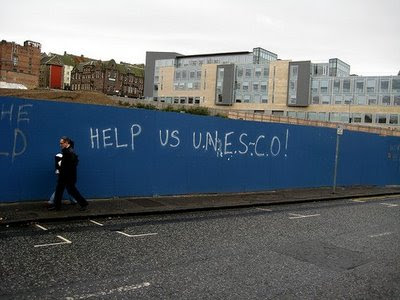
The biggest ‘holes in the ground’ are at Caltongate, between the Royal Mile and Waverley station, and the site of the former McEwan’s brewery at Fountainbridge, vacant since the brewery was shut down by Scottish & Newcastle in 2005.
HBOS reportedly paid up to £100 million for 12 acres of the former brewery site in March 2008 to build a state-of-the-art headquarters. But the plans were put on ice after the bank was bailed out by the taxpayer and taken over by Lloyds TSB.
RBS appears unable to decide what to do with the 2.5-acre plot it owns next door, inherited from its
client Buredi which planned to build flats and offices but went bust in February.
At Caltongate, developers Mountgrange fought a four-year battle with heritage groups before being granted permission to build a five-star hotel, homes, offices and shops.
But the project has been at a standstill since March, when Lloyds pulled the plug on Mountgrange. Administrators Deloitte have so far been unable to find any buyers.
This article was published in the Mail on Sunday (Scottish edition) on 10 January 2010