

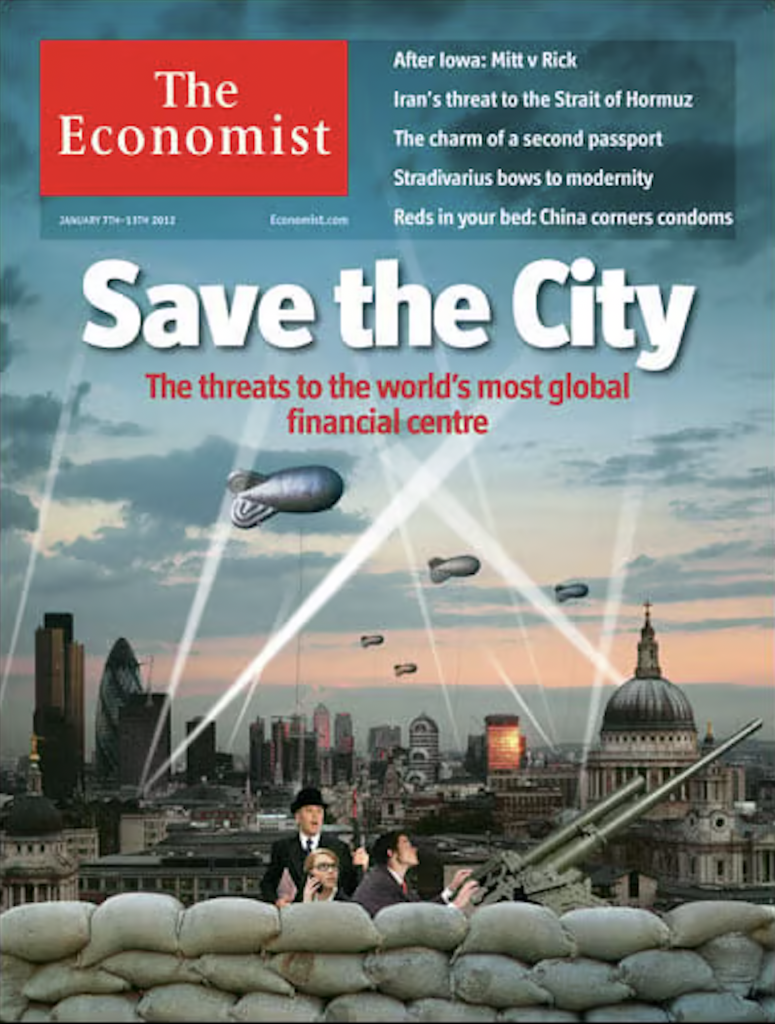
I was surprised and disappointed when I opened my copy of The Economist on Friday morning.
The magazine is running a feebly-argued propaganda piece headlined “Save the City” as its cover story. The piece vaunts the “skills” that are to be found in the City of London and seeks to persuade us that having a powerful financial sector is critical to the future health of the UK economy and that the “Square Mile” must therefore be cherished and preserved at all costs.
The cover image harps back to the Blitz of September 1940 to May 1941 during World War Two, as if Adolf Hitler’s Lufwaffe is once again poised to carpet bomb a key part of our heritage.
Outside PR puff sheets like HBOS’s absurd “Deal Leaders” of 2005-8 and the Pravda-style advertorials inserted into newspapers and magazines to launder the images of evil dictatorships, I’ve rarely read such a farcical or misleading article.
The magazine’s “Save the City” leading article is one-sided, snide, racist, xenophobic, and makes massive omissions. It doesn’t even start to acknowledge the multifarious failures of the financial sector, or the damage it has wreaked on the UK economy in recent years. The article fails to mention the massive risks posed by “crony capitalism” and “regulatory capture”, including wilful blindness to fraud, and even includes the words —
“Finance—the funnelling of savings to their best use—is a vital industry. Britain is very good at it, leading the world in various financial markets, including foreign exchange and over-the-counter derivatives. “
Who wrote this garbage I wonder?
Yes, the City did once fulfil the function of efficiently allocating capital, but that ended some 10 to 20 years ago when the ‘zero sum’ game of financial speculation for the self-enrichment of the participants took over.
As I have said before the City has, with a few exceptions, become the cuckoo in the nest of the UK economy.
It has become gigantic skimming machine/casino.
In addition to making taxpayer-underwritten bets it helps to diminish the savings and pensions of UK citizens, though high fees, spurious and unwarranted trading and an intermediated structure that favours the interests of the people that work in its own institutions (plus the people in their various suppliers including brokerages, law firms, accountancy firms, investment and actuarial consultancies, etc) over and above the long-term interests of savers and the needs of the wider economy.
The article includes the cross-head “Strangely, California doesn’t talk down Silicon Valley”. As several of the 144, mainly outraged, Economist readers who have commented on this piece said, such a claim is wide of the mark. One commenter, who uses the pseudonym jbunniii, wrote:-
“Strangely, California doesn’t talk down Silicon Valley.” That is because Silicon Valley produces tangible, useful things (in addition to less useful things such as Facebook). Financiers produce nothing and enrich themselves by skimming from other people’s transactions.
This intellectually lazy piece of journalism is a disgrace. More than any Economist article I’ve recently read (some of which have been excellent, by the way), it has made me give serious thought to cancelling my subscription to The Economist. I’ve heard that others are thinking along similar lines.
I’m kind of hoping there might be an internal rebellion at the magazine next week against whoever wrote or approved this cover story, and that the magazine will, at the very least, prominently publish an opposing view in its Friday 13th January issue. Publishing readers’ etters won’t suffice, I’m afraid.
This blog was posted on 7 January 2012
Pingback: At the core of the crisis for the elderly in this country is the greed of a few in the City of London » Tax Research UK
Thanks for these comments, John, Douglas and Richard.
If anyone has got this far and is interested in reading further comments on my piece, please take a look at the 70-odd comments on the Naked Capitalism version of the piece
Please feel free to add further comments here if you wish, though.
“A love note to London’s lengendary corrupt financial district” could not be more apt. It wouldn’t surprise me if the Economist article was drafted by someone in the Financial Ombudsman’s Service if my latest letter from them is anything to go by.
For some reason, there appears to be no inclination to seek distance from the on-going regulatory tolerance for the plundering of our economy via fraudulent and greed-driven business practices, so I can only assume the reasons for the endorsing the corrupt and powerful will, yet again, come down to some form of personnal gain.
See my recent blog on rot and the regulators